
Chinese money plants are famous for being passed around: a tiny pup in a paper cup, pinched off someone else’s plant, is how most people end up with one. That’s basically the plant’s whole personality — it multiplies itself so readily that most people get one from a friend rather than a store, and a healthy plant produces enough babies of its own to pass along the same way.
| Care factor | What it needs |
|---|---|
| Light | Bright, indirect; avoid direct sun over 1-2 hours |
| Water | Water when top 1-2 inches dry; avoid soggy soil |
| Soil | Well-draining mix with perlite |
| Propagation | Separate pups once they have a few leaves |
| Toxicity | Non-toxic to cats and dogs |
Light
Bright, indirect light keeps the round leaves full and compact, direct sun for more than an hour or two can scorch them, while too little light causes leggy, stretched-out growth with larger gaps between leaves. An east-facing window or a spot a few feet back from a south or west-facing one works well.
Watering
Water when the top inch or two of soil has dried out, then water thoroughly until it drains from the bottom of the pot. Chinese money plant wilts dramatically when it gets too dry, but it also recovers just as dramatically within hours of a good watering, so an occasional missed watering is rarely a serious problem. Consistently soggy soil is the bigger long-term risk and shows up as yellowing lower leaves or a soft stem.
Soil and potting
A well-draining potting mix with some added perlite works well, this plant doesn’t want to sit in dense, water-retentive soil. A pot with a drainage hole is important given how sensitive the plant is to consistently wet roots, and because it has a fairly shallow root system, it doesn’t need frequent repotting or an especially deep container.
Humidity and temperature
Typical indoor humidity is fine, this isn’t a fussy plant about air moisture the way some tropical houseplants are. It prefers average room temperatures and should be kept away from cold drafts near doors and windows, which can cause drooping and leaf damage even when watering is otherwise correct.
Fertilizing
A balanced liquid fertilizer diluted to about half strength, applied monthly during spring and summer, supports steady growth. Skip fertilizing in fall and winter when growth naturally slows down.
Propagation from pups
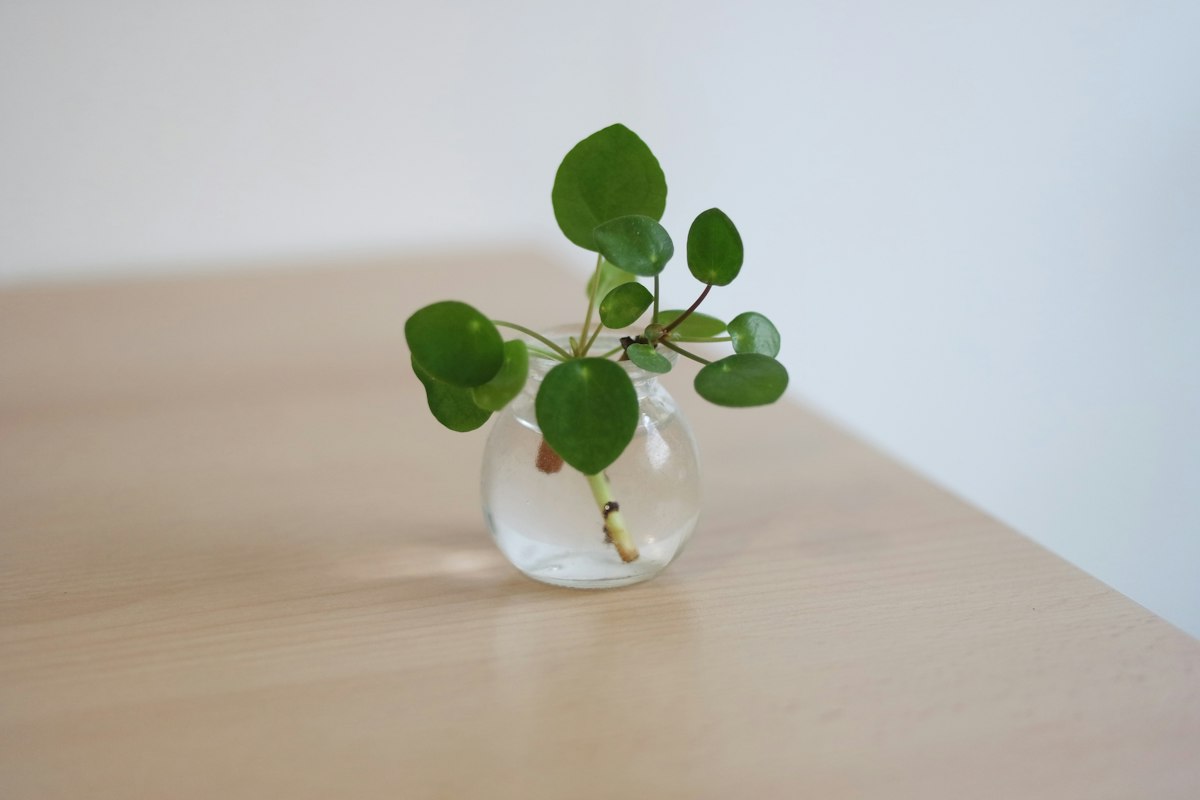
This is where Chinese money plant really stands out, it produces small plantlets, commonly called pups, around its base and sometimes along the stem, and propagating from these is far easier than most leaf or stem cutting methods used for other houseplants. Once a pup has grown a few inches and ideally has a bit of its own root development, gently separate it from the parent plant and pot it in its own small container with fresh soil. Pups without visible roots yet can also be placed in water until roots form, then transferred to soil. This ease of propagation is a big part of why the plant spreads so readily between friends and family.
Rotating for even growth
Chinese money plant is unusually phototropic, its leaves turn noticeably toward the nearest light source, which can leave a plant looking lopsided if it’s never turned. Giving the pot a quarter turn every few days keeps growth even on all sides and prevents the permanent sideways lean that develops when a plant faces the same direction for months at a time.
Common problems
Drooping is usually tied to underwatering, overwatering, or normal one-sided light reaching, our full guide on why Chinese money plant droops covers how to tell these apart. Yellowing lower leaves that drop occasionally are often just normal aging and nothing to worry about, especially on an older, more established plant.
A few things people ask
Is Chinese money plant toxic to pets? No, it’s considered non-toxic to cats and dogs, one of the safer options for households with curious pets.
Why is it called a money plant? The name comes from its round, coin-shaped leaves, in some cultures the plant is also considered a symbol of good luck or prosperity, which is part of why it’s such a popular gift.
How fast does it grow? Growth is moderate but steady in good conditions, and the plant reliably produces new pups throughout the growing season, so even a slow-growing individual leaf count is often offset by a growing cluster of babies at the base.
Should I mist my Chinese money plant? It’s not necessary, this plant does fine in average indoor humidity, and misting mainly just temporarily dusts the leaves rather than meaningfully changing the humidity around it. Next reads: Chinese Evergreen Care Guide: Light, Water, and Choosing a Variety, Why Are My Chinese Evergreen Leaves Curling or Drooping? and Fittonia (Nerve Plant) Care Guide: Light, Water, and Humidity.