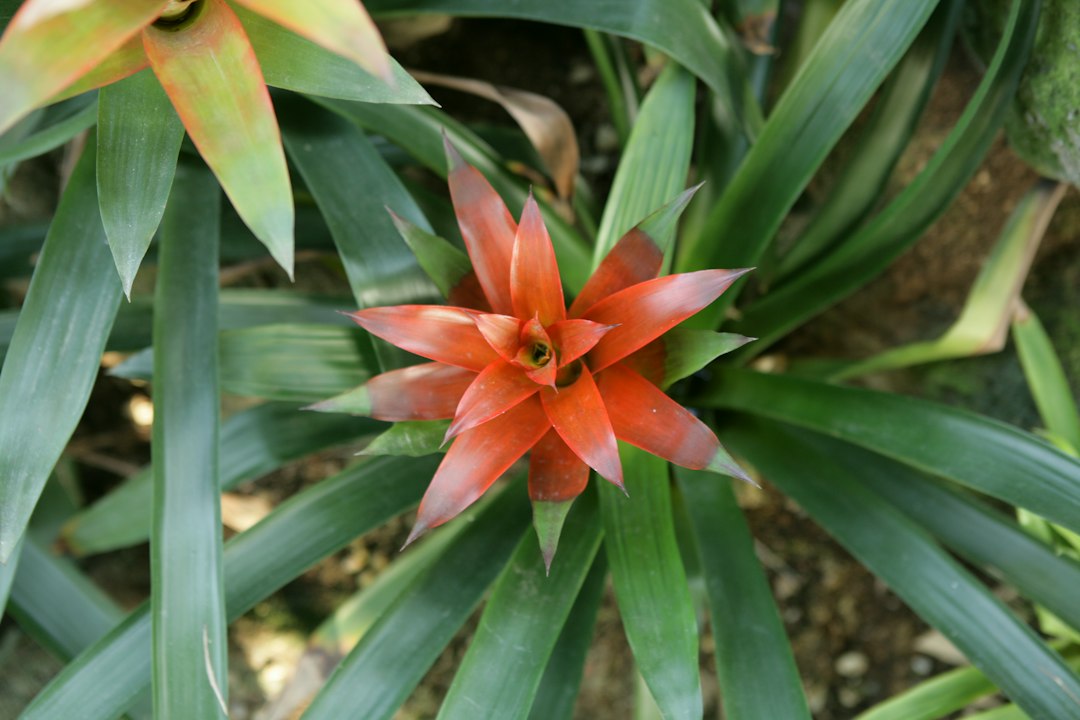
A grocery-store guzmania with a bright red star in the middle, bought on a whim in February because the kitchen looked gray, is perfect for about three months. Then the red starts fading to a dull orange-brown, the outer leaves go yellow at the tips, and the whole rosette slowly begins to slump. What most people do is water it more, move it to a sunnier window, and give it a dose of fertilizer for good measure.
None of that helps, because nothing is actually wrong. The plant is doing exactly what bromeliads are built to do. It has bloomed once, and now it is quietly handing things off to the next generation — little pups that often go unnoticed until the pot is tipped over to check the roots.
Not every dying bromeliad is that lucky, though. Rot, bad water, and harsh sun can all kill one for real. Here is how to tell which situation you are in.
Quick triage
Go through these in order. Most people land on their answer by the second or third question.
- Did the colorful center (the “flower”) bloom a while ago and is now fading or browning? If the plant flowered in the last several months, the slow decline is almost certainly the normal end of its life cycle. Look for pups at the base.
- Is the center of the rosette soft, brown, or slimy, and does it pull out with a gentle tug? That is crown rot, usually from stagnant water or soggy soil. This is the urgent one.
- Are the leaf tips brown and crispy, with a white crust in the cup or on the soil? Hard tap water and salt buildup are the likely culprits.
- Are there bleached, pale, or tan patches on the leaves facing the window? Too much direct sun.
- Did the leaves suddenly go dull, droopy, or water-soaked after a cold night or a spot near a drafty door? Cold damage.
| What you see | Likely cause |
| Slow fade after blooming, pups at the base | Normal post-bloom decline |
| Mushy center, leaves pull out easily, sour smell | Crown or root rot |
| Crispy brown tips, white crust in the cup | Hard water and salt buildup |
| Bleached or scorched patches on one side | Too much direct sun |
| Sudden dull, limp, or translucent leaves | Cold damage |
1. It already bloomed (and this part is normal)
This is the big one, and it is the reason so many bromeliads end up in the trash too early. Each bromeliad rosette flowers once in its life. The colorful part you bought it for — the red, pink, orange, or yellow “flower” — is mostly a set of colored bracts, and it can hold its color for two to six months. After that, the mother rosette stops making new leaves and gradually declines over the following months.
That sounds sad, but the plant is not finished. As the mother fades, she sends out offsets, usually called pups, from the base. Those pups are clones of the parent, and they are the whole point of this stage. The mother is basically feeding them with the energy she has left.
Signs you are looking at normal decline rather than a problem:
- The plant bloomed within the last several months.
- The decline is slow — weeks to months, not days.
- The center is still firm when you press it, even if the bract has gone brown.
- You can find one or more small rosettes growing at the base, sometimes tucked between the lower leaves.
What to do: cut the faded bract off near its base once it looks bad to you, keep caring for the plant as usual, and let the pups grow. Leave them attached until they are roughly a third to half the size of the mother. Our bromeliad care guide walks through separating and potting them up.
2. Crown rot or root rot
Bromeliads hold water in a central cup formed by their overlapping leaves, which is why so many care tags say to “water into the cup.” The trouble is that a cup full of water sitting in a cool, dim room for weeks becomes a little pond. It stagnates, and the base of the leaves starts to rot from the inside.
Soil can cause the same problem from below. Most bromeliads sold as houseplants grow on tree branches in the wild, and their roots are mainly for hanging on, not for drinking. Packed into dense, wet potting soil, those roots suffocate. The general mechanism is the same one we cover in root rot in houseplants.
Signs of rot:
- The center leaves turn brown or translucent at the base and feel soft.
- Leaves pull out of the rosette with almost no resistance.
- There is a sour or swampy smell from the cup or soil.
- The plant wobbles in the pot because the roots have given up.
What to do: tip out any water in the cup and let it stay empty while you assess. If the mother’s center is rotted through, she will not recover — but healthy pups at the base often can. Cut them away with a clean knife, let the cut dry for a day, and pot them in a loose, chunky mix. Going forward, keep the cup only partly filled, empty and refresh it every week or two, and let the soil approach dry between waterings. If you are not sure whether your watering is too much or too little in general, this guide to overwatering versus underwatering lays out the differences.
3. Hard water and salt buildup
Because bromeliads drink so much of their water through the cup and the leaf surfaces, whatever is dissolved in that water stays right there as it evaporates. Hard tap water and fertilizer residue leave a white, chalky crust in the cup and on the soil, and the leaves respond with brown, crispy tips that slowly creep inward. Guzmanias, the ones with the tall red or orange star, seem especially touchy about this.
What to do: flush the cup with clean water and tip it out. Switch to rainwater, distilled water, or filtered water if your tap water leaves spots on your kettle. Go light on fertilizer, and skip any product that lists copper — bromeliads are sensitive to it. Trim the brown tips at an angle with clean scissors if they bother you; they will not turn green again.
4. Too much direct sun
The common indoor bromeliads like bright light, but most of them grow under a canopy of trees in the wild, and hot direct sun through glass is more than they want. Sun damage shows up as pale, washed-out, or tan patches on the leaves facing the window, sometimes with a crispy edge. It tends to appear within a week of a move to a brighter spot.
What to do: move the plant back from the glass or behind a sheer curtain. Damaged patches will not repair themselves, but new growth will come in normal. Neoregelias, the flat rosettes that blush red in the middle, can take more light than guzmanias and actually color up better with it — just introduce them to stronger light gradually.
5. Cold damage
Bromeliads are tropical, and they do not like being cold, especially with water sitting in the cup. A night near a single-pane window in winter or a spot by a door that opens to freezing air can leave leaves dull, limp, and slightly translucent within a day or two.
What to do: move the plant somewhere that stays above about 60°F, and keep the cup empty until it warms back up. Cold-damaged leaves often brown and need trimming later, but if the center stays firm, the plant usually pulls through.
A few things people ask
Can I make my bromeliad bloom again?
Not the same rosette. Each one blooms once. The pups, though, will bloom on their own once they reach maturity, which usually takes one to three years depending on the type and how much light they get.
Should I cut off the mother plant once the pups appear?
Not right away. The mother is still feeding the pups. Wait until the pups are a third to half her size, then either separate them or cut the mother away once she has mostly dried up and leave the pups growing in the same pot.
Do I have to keep water in the cup?
No, and indoors it is often safer not to keep it full. A little water in the cup is fine if you dump and refresh it every week or two. In a cool or dim room, watering the soil lightly and keeping the cup mostly empty is the lower-risk approach.
Why is the colorful part turning brown but the leaves look fine?
That is the bract aging, and it is the most normal thing a bromeliad does. Cut it off at its base when it looks tired. The leaves can stay healthy for months afterward while the pups develop.
If your bromeliad is healthy and you just want the full routine — light, watering the cup, potting up pups, and coaxing a mature pup to bloom — see our bromeliad care guide. Next reads: Why Is My Air Plant (Tillandsia) Turning Brown or Dying?, Why Is My Staghorn Fern Turning Brown? and Why Is My Haworthia Turning Brown or Mushy?.