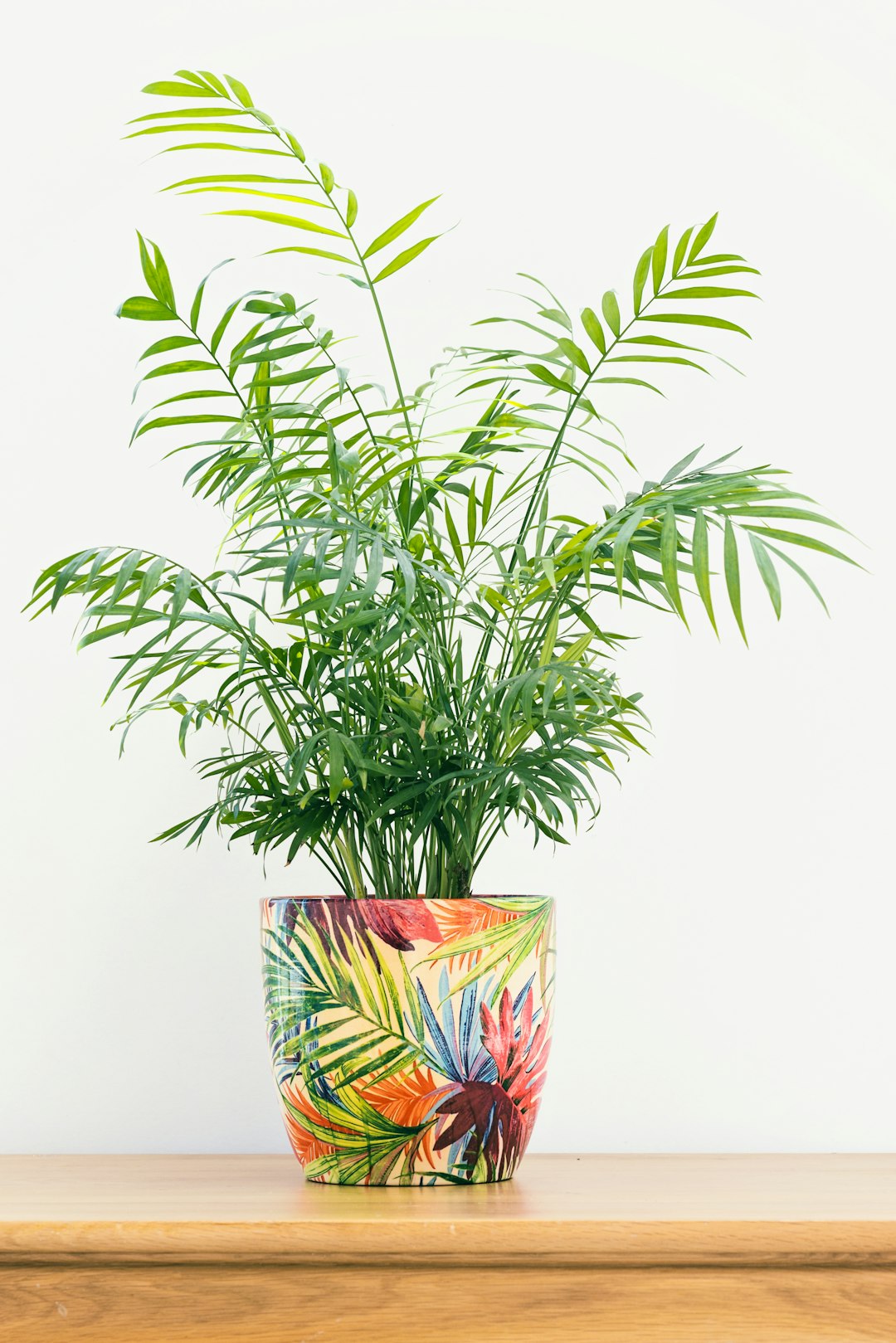
A parlor palm is one of the easier choices for an office, because the tag says it can handle low light, and it is right: a filing cabinet about ten feet from a north window is a perfectly workable spot. Where it runs into trouble is the opposite move — putting it somewhere that seems like it should make it happier, near a sunny window and a radiator, and finding out what it does not like.
Chamaedorea elegans is a small, slow palm from the rainforest understory of southern Mexico and Guatemala. It grows in clumps of thin green stems topped with soft, arching fronds, usually reaching two to four feet indoors over many years. It has been a houseplant since Victorian times, which is where the name comes from: it was one of the few plants that coped with dim, gas-lit parlors. It is also non-toxic to cats and dogs, which is rare for a plant this easy.
| Care area | What it needs |
|---|---|
| Light | Medium to bright indirect light, copes with low light; no strong direct sun |
| Water | When the top inch is dry; keep lightly moist, never soggy |
| Soil | Regular potting mix with some perlite or bark for drainage |
| Humidity | Average is fine, 40 percent or higher keeps the tips cleaner |
| Temperature | 65 to 80°F, keep above 50°F and away from heat vents |
| Fertilizer | Diluted feed a few times in spring and summer |
| Pets | Non-toxic to cats and dogs |
Light
Parlor palms will tolerate low light better than almost any other palm, but tolerate is the key word. In a dim corner they stay alive and grow very slowly. In medium to bright indirect light, a few feet back from an east or north window, or well back from a south one, they grow noticeably faster and fuller.
What they do not want is hot direct sun. The fronds are thin and scorch easily, turning pale and brown at the edges. A little morning sun is fine. If you only have a very bright south or west window, pull the plant back or put a sheer curtain between it and the glass.
Watering
This is where most parlor palm problems start. The plant wants to stay lightly moist, which is different from both dry and wet. A good rule is to water when the top inch of soil feels dry, water thoroughly until it runs out of the drainage hole, and empty the saucer. In a warm room that is roughly once a week; in winter it might be every ten days or two weeks.
Letting it go completely dry now and then will not kill it, but it is one of the main causes of brown frond tips. Keeping it soggy is worse, because the roots rot. A pot with a drainage hole is not optional with this plant.
Soil and potting
Standard indoor potting mix works well, with a handful of perlite or fine orchid bark mixed in to keep it from packing down. Nothing special is needed.
Parlor palms have fairly delicate roots and do not enjoy being disturbed, so repot only when you have to, usually every two or three years when roots are circling the bottom or pushing out of the drainage hole. Go up just one pot size. And plant it at the same depth it was growing before; burying the stems deeper invites rot at the base.
Humidity and temperature
Normal household humidity is enough to keep a parlor palm alive. More humidity, around 40 to 50 percent, is what keeps the frond tips from browning, which is the most common complaint. Grouping plants together, or running a humidifier in winter, helps a lot. Placement matters even more: keep it away from radiators, heat vents, and air conditioning, which dry the fronds out fast.
Ordinary room temperatures of 65 to 80°F are ideal. It does not like cold drafts or anything below about 50°F, so keep it off a cold windowsill in winter.
Fertilizing
Parlor palms are light feeders and slow growers, so it is easy to overdo it. A balanced liquid houseplant fertilizer at half strength, given once a month in spring and summer, is plenty. Skip it entirely in autumn and winter. Too much fertilizer shows up as brown tips and a white crust on the soil, and the fix for that is flushing the pot with plain water.
Propagation
Here is the honest version: you cannot really propagate a parlor palm from cuttings. Palms grow from a single growing point at the top of each stem, and a cut stem will not root. The only home method is division.
That works because the plant you bought is almost certainly not one palm. Growers plant a dozen or more seedlings in each pot to make it look full, so what looks like one bushy plant is actually a crowd. In spring, you can ease the root ball out and gently tease apart a clump of a few stems with their roots attached, then pot each clump separately. Expect some sulking and a lost frond or two afterwards. Growing from seed is possible but slow and fiddly, and not something most people need to bother with.
Why your parlor palm is really a pot of seedlings
This is worth knowing early, because it explains a lot of odd parlor palm behavior. Each thin stem in the pot is its own individual palm, with its own small root system, and it grows only from its tip. That has a few consequences.
- You cannot prune it bushier. If you cut the top off a stem, that stem is finished. It will not branch. The only fronds you should remove are dead or dying ones, cut near the base.
- Some stems will fade out over time. In a crowded pot, the strongest seedlings outcompete the weaker ones, and a few stems will slowly yellow and die, usually around the edges. That is competition, not disease, as long as the rest of the plant is producing new fronds.
- A thin pot will not fill back in. A parlor palm does not send up new shoots from the base like a snake plant. If yours has thinned out, the only way to make it fuller is to pot a second small palm in alongside it.
- Division is gentler than it sounds. Because the stems are separate plants to begin with, you are not really cutting a plant apart, just separating neighbors.
Once this is clear, an occasional dead stem is less worrying, and there is no reason to try to trim the plant into shape.
Common problems
Brown frond tips are by far the most common issue, and they usually come down to dry air, uneven watering, or a spot too close to a heater. The causes and how to tell them apart are covered in why your parlor palm has brown tips. Yellowing lower fronds and soggy soil point to overwatering; see root rot in houseplants if you suspect the roots. Parlor palms are also a favorite of spider mites in dry indoor air, so if you see fine webbing or speckled, dull fronds, rinse the plant in the shower and keep an eye on it.
A few things people ask
How fast does a parlor palm grow?
Slowly. In good conditions you might get a few new fronds per stem each year and a few inches of height. In low light, even less. They are sold at the size you see for a reason, and a four-foot parlor palm is usually many years old.
Is a parlor palm safe for cats and dogs?
Yes, it is listed as non-toxic to both. That makes it one of the better palm choices for pet owners, since some other plants sold as palms, such as the sago palm, are highly toxic.
Is a parlor palm the same as a ponytail palm?
No, and neither is a ponytail palm a real palm. It is a succulent with a swollen trunk that stores water, so it needs much drier care. If you have one of those, our ponytail palm care guide is the one to follow.
Will a parlor palm flower indoors?
Sometimes, on a mature plant in good light. The flowers are small yellow beads on branching stalks, and they are not especially showy. Some people cut them off to save the plant energy, but leaving them does no real harm. Next reads: Areca Palm Care Guide: Light, Water, and Feeding a Hungry Palm, Why Are My Areca Palm Leaves Turning Yellow? and Yucca Care Guide: Light, Water, and Cutting Back the Cane.