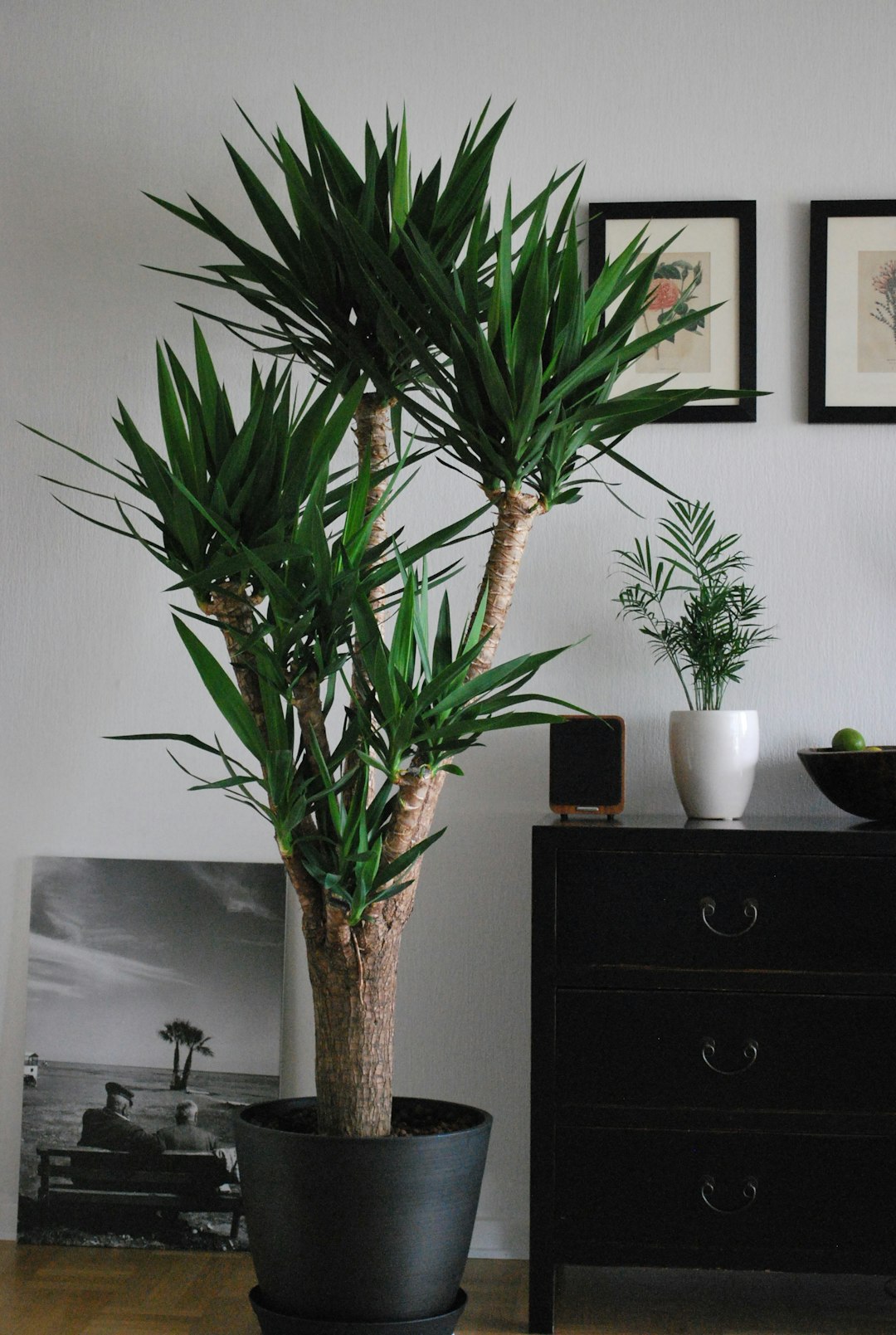
A yucca grows faster than most people expect, and it is easy to be pleased with it right up until the top leaves start bending sideways against the ceiling. At that point the decision is whether to saw the plant in half. Sawing is the right answer: the stump sprouts new heads just below the cut, and the top, rooted in a pot of gritty mix, becomes a second plant. The result is two plants and a lot less anxiety about pruning.
The yucca sold as a houseplant is almost always Yucca elephantipes (you will also see it labelled Yucca gigantea or spineless yucca). In Mexico and Central America it grows into a branching tree thirty feet tall. Indoors it is a cane plant: thick, woody trunks topped with rosettes of stiff, sword-shaped leaves. It wants more sun and less water than most people give it, and in return it is one of the toughest floor plants you can buy.
| Care area | What it needs |
|---|---|
| Light | Bright light with some direct sun; the brightest spot you have |
| Water | Only when the top half of the soil is dry; much less in winter |
| Soil | Fast-draining, gritty mix such as cactus soil with extra perlite |
| Humidity | Ordinary room air is fine |
| Temperature | 60 to 85°F, tolerates brief dips toward 40°F if dry |
| Fertilizer | Diluted balanced feed a few times in spring and summer |
| Pets | Toxic to cats and dogs if chewed (saponins) |
Light
Give a yucca the sunniest window in the house. A south or west window where it gets several hours of direct sun is ideal, and an east window is fine. It will survive in a medium-bright room, but it will grow slowly, the new leaves will be narrow and soft, and it will lean hard toward the glass.
A lot of yuccas end up in dim hallways and corners because they look like statement floor plants. That is the single most common reason they decline. If the plant is already big and the only bright spot is across the room, it is worth moving the furniture rather than the light requirements.
Yuccas do well outdoors in summer, but harden them off over a couple of weeks. Leaves grown indoors burn surprisingly easily in full outdoor sun.
Watering
Water deeply, then wait. Push a finger or a wooden chopstick a few inches into the soil and only water once the top half of the pot is dry. For a large floor plant in a sunny room in summer, that might be every ten days to two weeks. In winter, in a cooler room, it can easily be once a month.
When you do water, soak it until water runs from the drainage hole, then empty the saucer. Never leave the pot standing in water. The cane and the roots store plenty of moisture, so a yucca that is a little too dry for a week will barely notice. A yucca that is a little too wet for a month can lose a cane.
Soil and potting
Use something that drains fast. Bagged cactus and succulent mix with an extra handful or two of perlite or pumice works well, or regular potting mix cut roughly half and half with grit. Peaty soil on its own holds far too much water for this plant.
Tall yuccas get top-heavy, so a terracotta or ceramic pot is a better choice than a light plastic one. It is heavier, and terracotta lets the soil dry out a bit faster too. Repot every two or three years in spring, going up only one size. Yuccas are happy slightly root-bound, and a huge pot full of wet soil is asking for rot.
Humidity and temperature
This is one plant you do not need to worry about humidity for. Dry winter air from the heating does it no harm at all, which makes it a good choice for rooms where ferns and calatheas struggle.
Normal room temperature is fine. Yucca elephantipes copes with a cool room in winter, and short dips toward 40°F will not kill it as long as the soil is dry. What it does not like is cold combined with wet roots, so in a chilly room, water even less.
Fertilizing
Yuccas are light feeders. A balanced liquid houseplant fertilizer at half strength, two or three times between spring and late summer, is plenty. Skip it entirely in autumn and winter. Too much fertilizer shows up as brown leaf tips and a white crust on the soil, and it does not make a yucca in low light grow any faster.
Propagation
There are two easy ways. The first is offsets: mature yuccas often send up small pups from the base. When a pup is several inches tall, unpot the plant, cut the pup away with a piece of root if you can, and pot it on its own in gritty mix.
The second is cane cuttings, which is really the same thing as cutting back a tall plant, so it is covered in the next section. Leaf cuttings do not work with yucca.
Cutting back a tall yucca, and why the stump grows back
This is the part of yucca care that makes people nervous, and it should not. A yucca cane does not branch the way a normal shrub does. Each cane keeps growing from the single rosette at its tip, getting taller and taller, until it hits the ceiling or flops over. Pinching the tip does nothing useful. The only way to control height is to cut the cane itself.
The interesting thing is what happens next. The cane is full of dormant buds under the bark. As long as the growing tip is in charge, those buds stay asleep. Cut the tip off, and one to three of the buds just below the cut usually wake up and grow into new heads. That is why so many store-bought yuccas have a flat-topped cane with two or three rosettes sprouting from the sides near the top: the grower cut a long cane into sections, rooted them, and let them sprout.
How to do it:
- Do it in spring or early summer, when the plant is actively growing. Winter cuts take much longer to sprout.
- Use a clean, sharp saw or serrated knife and cut straight across the cane at the height you want, keeping in mind the new heads will appear a few inches below the cut.
- Seal the top of the stump with a dab of candle wax or pruning sealant to stop it drying out and rotting. Then water lightly and put it in good light.
- For the top piece, trim off the lower leaves, let the cut end dry for a few days until it callouses, and stand it a couple of inches deep in barely damp gritty mix. Keep it on the dry side. Roots usually form in four to eight weeks, and new leaf growth is the sign it has taken.
- If the top piece is very long, you can cut it into more than one section. Just remember which end was up, because a section planted upside down will not root.
It looks brutal for a few weeks, with a bare stump and no leaves, but it is the normal way to keep an indoor yucca at a sensible size, and you get free plants out of it.
Common problems
Yellowing leaves are the most common complaint, and they almost always come down to too much water, too little light, or normal shedding of old leaves. Our article on why yucca leaves turn yellow walks through how to tell those apart. A soft or wrinkled cane base means rot; see root rot in houseplants. Pale, stretched new leaves that flop over are a light problem. In very dry rooms spider mites sometimes turn up as fine speckling on the leaves; a rinse in the shower and a wipe of the leaves usually sorts it out.
A few things people ask
Is yucca toxic to cats and dogs?
Yes. Yucca contains saponins, and the ASPCA lists it as toxic to cats and dogs. Chewing on the leaves usually causes vomiting and drooling rather than anything life-threatening, but it is worth keeping it away from pets that like to nibble.
Are yucca leaves sharp?
The spineless yucca sold indoors does not have the stiff, needle-tipped leaves of the outdoor garden yuccas, but the leaf tips are still pointed and the edges can be slightly rough. Keep it out of narrow walkways and away from where small children play at face height.
How fast does an indoor yucca grow?
In a sunny spot, quite fast for a houseplant, often six inches to a foot of cane height a year. In low light it barely grows at all. That speed is the reason most people eventually need to cut one back.
Is a yucca the same as a ponytail palm or a dracaena?
No, though they get mixed up constantly. A ponytail palm has a swollen, bulb-like base and thin, curly leaves; our ponytail palm care guide covers it. Dracaenas have softer leaves and smoother canes and want more water and less sun than a yucca does. Next reads: Ti Plant Care Guide: Light, Water, and Keeping the Color Bright, Parlor Palm Care Guide: Light, Water, and Growth Habits and Areca Palm Care Guide: Light, Water, and Feeding a Hungry Palm.